University of Geneva
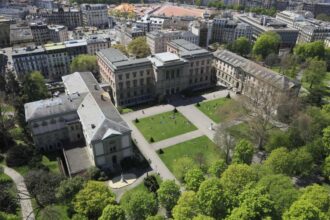
Geneva, SionThe University of Geneva – known as UNIGE – is located in the heart of a vibrant, international city that is nestled between the shores of Lake Geneva, the Alps and the Jura mountains. Geneva is also home to a large number of international organizations, NGOs and multinationals. All this provides the ideal setting for a well-rounded, fulfilling and successful learning experience.
But it’s not just about the location – our university also boasts no fewer than nine teaching faculties and 13 cross-disciplinary institutes and centers, in which experts and students from a range of fields come together to hone the skills they need to build a more sustainable future for us all. And our cutting-edge teaching and research have garnered international recognition: We rank among the top 100 universities in the world, and UNIGE professors received two Nobel Prizes in Physics in 2019 and another Fields Medal in 2022.
In today’s ever-changing world, it’s important to be constantly looking for solutions – we need brainpower, know-how and drive if we are to combat climate change, keep pace with the digital age, revive multilateralism and successfully navigate public health and other crises. The challenges we currently face are unprecedented, but as a university we’re training the next generation of individuals capable of tackling them.
Each year, close to 18,000 students are part of this quest. Would you like to join them?
Faculties and Interdisciplinary Centers
The University of Geneva offers a wide array of high-level programs through nine Faculties (Science, Medicine, Humanities, Social Sciences, Economics and Management, Law, Theology, Psychology and Educational Sciences, Translation and Interpreting) and fourteen interdisciplinary Centres and programs (Global Studies Institute, Computer Science Centre, University Teacher Training Institute, etc.). The University also hosts several National Centres of Competence in Research (NCCRs).
Programs
More than 580 programs are on offer at UNIGE, including 104 Bachelor’s and Master’s degree programs, 91 doctoral programs, and more than 390 continuing education programs. Disciplines covered include Neuroscience, Environmental Sciences, Finance, Bioethics, Human Rights, International Relations, Genetics, Affective Sciences, History, and many more.
UNIGE is also
- A global university: about 40% of students, 60% of academic staff and 67% of doctoral students come from abroad.
- An institution open to the world’s elite: UNIGE constantly works to establish and expand relations internationally. Thanks to these efforts, UNIGE has hosted several Nobel laureates and recipients of other distinguished prized, as students, researchers and/or professors (e.g: Kofi Annan, Nobel Peace Prize 2001; Stanislav Smirnov, Fields Medal 2010; Michel Mayor and Didier Queloz, Nobel Physics Prize 2019).
- One of the most active centers for multilateral diplomacy and global governance. UNIGE is fully integrated in this international landscape and plays a major role as an essential and respected partner to the «International Geneva». UNIGE has established several collaborative agreements with major international organizations, such as the United Nations (UN), the World Health Organization (WHO), the World Intellectual Property Organization (WIPO), the UNDP, the ICRC, and CERN, among others.
- A member of prestigious academic networks such as the League of European Research Universities (LERU), which unites the 23 best research universities in Europe, or the Coimbra Group, an association of long-established European multidisciplinary universities of high international standards.
- An institution with competitive research funding and world-class research findings and host of several cutting-edge research infrastructures (eg: Biotech Campus, Centre for Biomedical Imaging, etc.).
- One of the most active Swiss players for competitive European and international research grants, in particular 50 prestigious ERC grants and over 300 FP7 and H2020 grants, as well as numerous European COST networks and US-NIH subsidies.
RESEARCH + TEACHING AREAS
- Arts
- Communication Sciences
- Computer Science
- Economics, Political Science
- Historical and Cultural Sciences
- Language Sciences, Literature
- Law
- Mathematics and Natural Sciences
- Medicine, Pharmacy and Health
- Social Sciences, Social Work
- Teacher Education, Special Pedagogy, Educational Science, Subject-specific Didactics
- Theology, Sciences of Religion
DEGREE PROGRAMMES
- Number of Bachelor programmes: 30
- Number of Master programmes: 76
- Number of PhD programmes: 91
- Number of programmes in continuing education: 372
At a glance
FOUNDED IN 1559
18200 STUDENTS
40% INTERNATIONAL STUDENTS
1000 CHF TUITION FEES/SEMESTER FOR INTERNATIONAL STUDENTS (2026/27)
2025 SHANGHAI RANKING 58th
NOBEL PRIZE: 9
MEDALISTS AND AWARDS: 5
Hugo Duminil-Copin, Fields Medal
Michel Mayor et Didier Queloz, Nobel Prize in Physics
Jacques Dubochet, Nobel Prize Chemistry 2017
Martin Hairer, Fields Medal 2014
Antoine Bailly, Vautrin-Lud Prize 2011
Stanislav Smirnov, Fields Medal 2010
Alan Jay Heeger, Nobel Prize Chemistry 2000
Martin Rodbell, Nobel Prize in Physiology or Medicine 1994
Edmond Henri Fischer, Nobel Prize in Physiology or Medicine 1992
Vaughan Jones, Fields Medal 1990
Niels Kaj Jerne, Nobel Prize in Physiology or Medicine 1984
Werner Arber, Nobel Prize in Physiology or Medicine
Daniel Bovet, Nobel Prize in Physiology or Medicine
Norman Angell, Nobel Peace Prize 1933